Social Housing Provider Fined £140,000 for HAVS Exposure
Stonewater Limited, a social housing provider based in Leicester, was fined £140,000 and ordered to pay £3,742 in costs at Birmingham Magistrates’ Court on 14 April 2025 after two of its employees were diagnosed with Hand Arm Vibration Syndrome (HAVS) following repeated exposure to vibrating tools.
Key Details of the Case:
- The two employees, working as estate assistants near Tanyard Farm in Coventry between 2018 and 2023, performed ground maintenance tasks including grass cutting, hedge trimming, litter picking, and weeding.
- Their duties required extensive use of vibrating equipment such as lawn mowers, leaf blowers, strimmers, and hedge cutters. One employee estimated he used these tools for 90% of his working day.
- Both men were diagnosed with HAVS in July 2023. HAVS is a serious and disabling condition affecting the nerves, blood supply, joints, and muscles of the hands and arms, resulting from prolonged exposure to vibration. Symptoms include loss of fine motor skills, pain, and difficulty performing everyday tasks.
Failures Identified by HSE:
- Stonewater Limited failed to undertake a risk assessment related to vibration exposure.
- The company did not regularly or accurately record vibration exposure levels to reduce risks.
- There was no information, instruction, or training provided to employees about vibration risks.
- Stonewater did not implement a suitable system of health surveillance for employees using vibrating tools.
Legal Outcome:
- Stonewater Limited pleaded guilty to breaching Section 2(1) of the Health and Safety at Work etc. Act 1974.
- The case was prosecuted by the Health and Safety Executive (HSE), with lead inspector Charlie Rowe emphasizing the seriousness of HAVS and the importance of employer responsibilities in managing health and safety risks.
Impact on Employees:
One affected employee, Christopher Smith, described significant impacts on his daily life, including loss of fine motor skills, difficulty using utensils, and fear of dropping his grandchildren due to reduced hand function and pain.
HSE Statement:
Lead inspector Charlie Rowe stated: “This is a tragic case and the fine imposed on Stonewater Limited underlines that the courts, and HSE, take a failure to follow health and safety regulations extremely seriously. HAVS is a serious and disabling health condition, and we will not hesitate to take action against employers that fall below the required standard.”
Hand Arm Vibrations at Work

Hand-arm vibration comes from the use of hand-held power tools and is the cause of significant ill health (painful and disabling disorders of the blood vessels, nerves and joints).
Worried about your hands?
Advice for workers:
- You could be risking damage to nerves, blood vessels and joints of the hand, wrist and arm if you work regularly with hand-held or hand-guided power tools for more than a few hours each day.
- Hand Arm Vibration Syndrome (HAVS) caused by exposure to vibration at work is preventable, but once the damage is done it is permanent.
- The Control of Vibration at Work Regulations 2005 were introduced to better protect workers from vibration at work and came into force in July 2005.
Am I at risk?
You are at risk if you regularly use hand-held or handguided power tools and machines such as:
- Concrete breakers, concrete pokers.
- Sanders, grinders, disc cutters.
- Hammer drills.
- Chipping hammers.
- Chainsaws, brush cutters, hedge trimmers.
- Powered mowersy.
- Scabblers or needle guns.
You are also at risk if you hold workpieces, which vibrate while being processed by powered machinery such as pedestal grinders.
You are particularly at risk if you regularly operate:
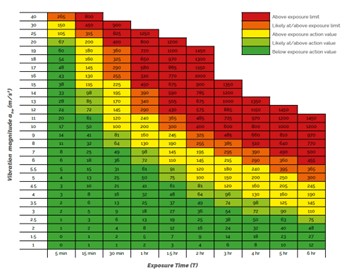
- Hammer action tools for more than about 15 minutes per day.
- Some rotary and other action tools for more than about one hour per day.
As you are likely to be above the exposure action value set out in the regulations.
What are the early signs and symptoms to look out for?
- Tingling and numbness in the fingers (which can cause sleep disturbance).
- Not being able to feel things with your fingers.
- Loss of strength in your hands (you may be less able to pick up or hold heavy objects)
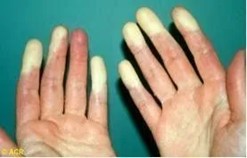
- In the cold and wet, the tips of your fingers going white then red and being painful on recovery (vibration white finger).
If you continue to use high-vibration tools these symptoms will probably get worse, for example:
- The numbness in your hands could become permanent and you won’t be able to feel things at all.
- You will have difficulty picking up small objects such as screws or nails.
- The vibration white finger could happen more frequently and affect more of your fingers.
People’s own stories
Mechanical repair
A former mechanic technician hopes that by sharing his experiences with others, this may help save them some of the pain and financial worries that he is experiencing. He used and repaired a wide range of hand-held power tools, including chainsaws, but was signed off work in his 50s with vibration white finger:
‘HAVS has affected my day-to-day living. I have a loss of manual dexterity and find it very difficult to use my fingers, in particular my thumbs, coupled with loss of feeling and sensations in various sections of my hands. Gripping with my thumbs is very difficult and painful, for example when using a brush. I dread the cold winter months and even during at rest periods I experience coldness and painfulness. I can no longer do some of the hobbies I used to enjoy, like swimming and angling.’
Heavy fabrication
A former technician (56) who worked with pneumatic tools describes his experiences.
“I suffer from very cold hands, they’re worse in winter than in summer but they’re still cold at this present day even though it’s a warm day. When I used the tools, sometimes there’s a frost on the tools, the pneumatic tools, when you’ve used them and that accentuates the feeling and they’re dead very dead, numb all the while. I have difficulties picking up things, small things, pushing buttons. I drop things more and don’t know the amount of pressure I’m putting on finger and thumb”
Shipbuilding
Another worker (35) describes the effects HAVS has had on his life and leisure.
“I play darts, can’t do that any more, I can’t do freshwater fishing, can’t feel the lines, fine lines between the fingers, can’t feel them at all. Can’t pick up small screws, DIY, quite a few things I can’t do a lot of now. I can’t turn over the pages in a paper, you have to wet your fingers all the time because you can’t feel the paper between the fingers”
Tasks and industries
Which jobs and industries are most likely to involve hand-arm vibration?
Jobs requiring regular and frequent use of vibrating tools and equipment and handling of vibrating materials are found in a wide range of industries, for example:
Building and maintenance of roads and railways
Construction
Estate management (eg maintenance of grounds, parks, water courses, road and railside verges)
Forestry
Foundries
Heavy engineering
Manufacturing concrete products
Mines and quarries
Motor vehicle manufacture and repair
Public utilities (eg water, gas, electricity, telecommunications)
Shipbuilding and repair
Tools
What kinds of tools and equipment can cause ill health from vibration?
There are hundreds of different types of hand-held power tools and equipment, which can cause ill health from vibration. Some of the more common ones are:
Chainsaws
Concrete breakers/road breakers
Cut-off saws (for stone etc)
Hammer drills
Hand-held grinders
Impact wrenches
Jigsaws
Needle scalers
Pedestal grinders
Polishers
Power hammers and chisels
Powered lawn mowers
Powered sanders
Scabblers
Strimmers/brush cutters
How do I protect myself?
It is your employer’s responsibility to protect you against HAVS and carpal tunnel syndrome, but you should help by asking your employer if your job could be done in a different way without using vibrating tools and machines. If this cannot happen:
- Ask to use suitable low-vibration tools.
- Always use the right tool for each job (to do the job more quickly and expose you to less hand-arm vibration).
- Check tools before using them to make sure they have been properly maintained and repaired to avoid increased vibration caused by faults or general wear.
- Make sure cutting tools are kept sharp so that they remain efficient.
- Reduce the amount of time you use a tool in one go, by doing other jobs in between.
- Avoid gripping or forcing a tool or workpiece more than you have to.
- Store tools so that they do not have very cold handles when next used.
- Encourage good blood circulation by:
- Keeping warm and dry (when necessary, wear gloves, a hat, waterproofs and use heating pads if available);
- Giving up or cutting down on smoking because smoking reduces blood flow; and
- Massaging and exercising your fingers during work breaks.
What else can I do?
- Learn to recognise the early signs and symptoms of HAVS.
- Report any symptoms promptly to your employer or the person who does your health checks.
- Use any control measures your employer has put in place to reduce the risk of HAVS.
- Ask your trade union safety representative or employee representative for advice.
Where can I find out more?
For more information on vibration:
HSE’s free leaflet Hand-arm vibration – Advice for employees (INDG296) (pocket card contains notes on good practice which you may find helpful)
Download HSE’s free leaflet Control the risks from hand-arm vibration – Advice for employers on the Control of Vibration at Work Regulations 2005 (INDG175 – rev2) (leaflet for employers on good practice and considering what they need to do)
You can also order a copy of these publications through HSE Books.
Who can help?
Your employer has a duty to protect you and should be working on measures to reduce the risk. The law says your employer has to find out what levels of vibration you are exposed to and assess the risk to your health from vibration at work.
Safety Representative/ Employee representative. Trade-union-appointed safety reps or other employee representatives can be very useful in communicating problems, inspecting documents and consulting employers over measures to meet these regulations.
Your Company Doctor or your GP. This may be an occupational health professional where you have a company occupational health scheme or your general practitioner through the NHS.

Speak with our Safety Experts