Thank You for Supporting My London Marathon Fundraising
 I want to say a huge thank you to all clients and colleagues who have supported my fundraising for the 2026 TCS London Marathon. Your generosity, messages of support and encouragement over the last few months have been genuinely appreciated and have made the early starts and long training runs a lot easier to face.

Thanks to your donations, we have been able to raise valuable funds for a cause that means a great deal to me personally, and to the people it supports. Every contribution – large or small – has helped move the total forward and will make a real difference to those who benefit from the charity’s work.
The fundraising page will remain open for a short while after the marathon for anyone who still wishes to donate or share the link. After May’s newsletter, I will remove the regular marathon update from this bulletin, but please be assured that your support has been noticed and is very much appreciated. Thank you again for backing both the charity and the many miles of training that have gone into this event.
My charity page still remains live so If you’d like to support my fundraising effort, you can read more and donate via my official page here:
Darren Goble – 2026 London Marathon Fundraising Page
https://2026tcslondonmarathon.enthuse.com/pf/darren-goble
Any amount, large or small, will be genuinely appreciated and will go directly to supporting the charity’s work.
Newsletter Article – May 2026
Summer Working on Site – Heat, Hydration and Outdoor Risks
As we move towards summer, longer days and warmer weather can be good news for productivity on construction and housing sites. But higher temperatures, strong sun and extended working hours also bring their own health and safety risks, particularly for outdoor and physically demanding work. HSE’s guidance on outdoor working and heat stress makes it clear that employers must assess and control the risks from hot conditions just as they would any other workplace hazard.
Heat Stress – More Than Just Feeling Hot
Working hard in hot weather, especially in PPE, can q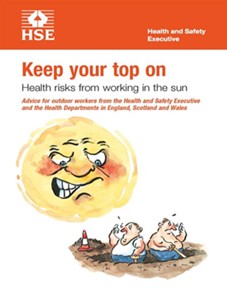 uickly lead to heat stress. This happens when the body can no longer cool itself effectively, leading to symptoms such as dizziness, headache, confusion, heavy sweating or, in severe cases, collapse. HSE advises employers to consider work rate, working climate (temperature, humidity, air movement, radiant heat), clothing/PPE and individual factors such as age, health and acclimatisation when assessing the risk.
On construction sites the risk is higher where:
- Heavy physical work is carried out in direct sun or hot, confined spaces.
- Workers wear impermeable or heavy PPE that traps heat.
- There is limited shade, poor air movement or reflective surfaces that intensify heat.
Ignoring early signs of heat stress can have serious consequences, particularly when people are working at height, near plant or in traffic routes.
Practical Controls – Planning, Breaks and Hydration
HSE’s outdoor working guidance sets out straightforward measures that make a big difference. In practice this means:
- Planning the work: Where possible, schedule the heaviest tasks and work in the most exposed areas for cooler parts of the day, such as early morning or later in the afternoon.
- Rest breaks and shade: Provide more frequent rest breaks in shaded or cooler areas and ensure welfare units or rest spaces are usable and comfortable in hot weather.
- Hydration: Give workers easy access to cool drinking water and actively encourage regular drinking – small amounts often, not just at breaks. Guidance suggests that on very hot days, workers may need a drink every 15–20 minutes during heavy work.
- PPE and clothing: Within safety requirements, allow lighter, breathable clothing and encourage workers to remove PPE during breaks to help cool down.
Supervisors should be briefed to watch for signs of heat stress, check on newer or more vulnerable workers, and be prepared to stop or modify work if conditions become unsafe.
Sun Exposure and Skin Protection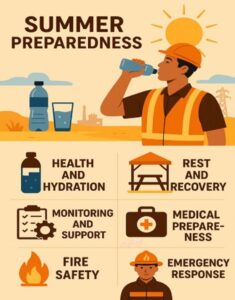
For outdoor workers, ultraviolet (UV) exposure is a significant long‑term health risk. HSE advises that sun exposure should be treated as a workplace hazard, with practical controls in place to reduce the risk of sunburn and skin cancer. Construction industry guidance emphasises simple but effective measures:
- Keep your top on: Wear lightweight, long‑sleeved clothing and long trousers where feasible, rather than working bare‑
- Hats and neck protection: Use hats or helmet attachments with a brim or neck flap to protect ears and the back of the neck.
- Shade where possible: Encourage workers to take breaks in shaded areas, particularly around midday when the sun is strongest.
- Sunscreen: Provide and encourage use of high‑factor (at least SPF 30), broad‑spectrum sunscreen on exposed skin, and remind workers to reapply regularly.
- Eye protection: Use UV‑protective safety glasses or sunglasses to protect eyes from glare and UV radiation.
Building simple “sun safety” messages into inductions, briefings and site signage helps normalise these behaviours and shows that employers take the issue seriously.
Particular Care for New Starters and Vulnerable Workers
Younger workers, new starters and those returning after illness or time away from site may be less acclimatised to working in heat and more reluctant to speak up if they feel unwell. Guidance on heat stress highlights that individual factors can significantly affect tolerance, meaning a one‑size‑fits‑all approach is not enough.
Practical steps include:
- Gradually building up workloads and exposure for new or returning workers over several days.
- Pairing less experienced workers with more experienced colleagues who can help spot early signs of heat stress.
- Encouraging an open culture where anyone feeling unwell is supported to stop and cool down, rather than pressured to “push through.”
Summer 2026 – Key Actions for Site Managers and Clients
For your sites and projects, the following points can help get ahead of summer risks:
- Add heat, sun and hydration to risk assessments and method statements for relevant tasks, especially outdoor, high‑effort or PPE‑heavy work.
- Check welfare and rest facilities are suitable for hot weather – shade, ventilation, cool drinking water and enough capacity for the workforce.
- Brief supervisors and workers on recognising heat stress and sun risks, and what to do if someone shows symptoms.
- Review work schedules and overtime for the summer period, especially on critical tasks at height or around plant, to avoid combining extreme heat with long hours.
- Consider a simple summer campaign – posters, toolbox talks and short messages reinforcing hydration, breaks and sun protection.
Handled well, summer conditions don’t need to slow projects down – but they do need planning and visible leadership to keep people safe and fit for work.

HSE Construction Safety Update – May 2026
Site Welfare Failings Lead to Court
A recent HSE prosecution against Ling Developments Limited has underlined that basic welfare standards are non‑negotiable. An inspection at a Telford housing site in 2024 found toilets with no hot or warm running water and no suitable rest facilities for workers. Two Improvement Notices were served but follow‑up visits identified continuing failures across multiple sites, leading to a £15,858 fine plus costs in April 2026. HSE stressed that hot running water and proper rest areas are the absolute minimum workers should expect – “not a luxury.”
Fatal Fall of Teenage Labourer
In March, Jerram Falkus Construction Limited was fined £40,200 plus costs after a 19‑year‑old labourer died falling six storeys down a ventilation shaft on a London project. HSE’s investigation found the shaft was covered only with plasterboard and foam, routine inspections did not include the roof garden area, and no warnings were given to the scaffolding team working nearby. HSE emphasised that falls from height remain one of the biggest causes of death and serious injury in construction, and that fragile or hidden openings must be properly protected, inspected and included in work at height risk assessments.
Repeated Breaches and Wider Management Failings
HSENI recently reported on a separate case in Northern Ireland where a contractor at a housing development continued to allow unsafe scaffolding and poor welfare despite repeated enforcement notices. Inspectors described “a complete disregard for basic health and safety requirements,” highlighting missing guardrails and inadequate facilities, and used the case to warn that persistent non‑compliance will lead to prosecution. Legal commentary on recent HSE prosecutions also notes a trend towards examining systemic management failings – risk assessment quality, CDM implementation, supervision and training – rather than treating incidents as isolated mistakes.
Priority Actions for May
- Check welfare against minimum standards: Hot/warm running water, clean toilets, usable rest facilities and drying space at every site, sized for the current workforce.
- Review protection of openings and fragile areas: Include vents, shafts, floor and roof openings in work at height inspections, with robust covers, edge protection and clear signage.
- Test your management system, not just the paperwork: Make sure risk assessments, CDM roles, supervision and training are working in practice, particularly on smaller or remote sites where standards can slip.
Environmental Focus for Summer 2026 – Dust, Waste, Water and Site Housekeeping
As activity increases through late spring and into summer, environmental standards on construction sites can come under pressure. Drier conditions, more groundworks, higher waste volumes and more vehicle movements all increase the risk of dust, pollution and poor site housekeeping. Good environmental management is not just about compliance – it also reflects the overall quality of site control and can have a direct impact on reputation, neighbour relations and project efficiency.
Dust and Air Quality
Dry weather often leads to more airborne dust from cutting, grinding, loading out and vehicle movements on haul roads. This can affect neighbouring properties, site operatives and the wider environment if not properly controlled. Practical controls include damping down exposed surfaces, using suitable extraction or suppression on cutting equipment, limiting unnecessary vehicle speeds and keeping site roads and work areas clean. Dust management should be considered as part of daily supervision, especially on housing developments close to occupied homes, schools or public routes.
Water Pollution and Concrete Washout
Summer programmes often bring more excavation, drainage work and concrete operations, all of which can create pollution risks. Silt, cement washout, fuels and oils must not be allowed to enter surface drains, ditches or watercourses, as these often discharge directly to the environment. Construction guidance recommends identifying all drains and watercourses on site plans, protecting gullies where necessary, and using designated washout and dewatering arrangements rather than allowing contaminated water to run freely across site. Spill response plans should be in place and understood by site teams before an incident occurs.
Waste Management and Housekeeping
Construction businesses remain responsible for storing, handling and transferring waste safely and legally. Waste must be stored securely in suitable containers, clearly labelled where necessary, and managed so it does not harm the environment. For each load of waste passed on, a waste transfer note is required, and copies must be kept for at least two years; hazardous waste movements require consignment notes, which must be retained for at least three years. Good segregation on site also reduces cost and helps improve recycling performance, while poor housekeeping can quickly lead to windblown litter, contamination and complaints.
Fuel, Oils and Chemical Storage
Fuel bowsers, generators, oils, paints and other chemicals can all cause serious pollution if stored or handled badly. Storage areas should be secure, clearly identified and protected against leaks, with spill kits located nearby and workers trained in how to use them. Refuelling and decanting should take place in controlled areas away from drains wherever possible, and any contaminated excavation water should never be pumped directly into surface drainage.
Four Quick Checks for May
- Check that dusty tasks and haul routes are being controlled daily, not just mentioned in RAMS.
- Confirm that skips, bins and waste storage areas are tidy, secure and supported by the correct documentation.
- Review drainage plans, spill arrangements and concrete washout areas before major groundwork or pour activity ramps up.
- Inspect fuel and chemical storage to ensure bunding, labelling and spill response arrangements are in place and usable.
Strong environmental performance is often a sign of strong site management overall. A tidy, well-controlled site is usually safer, more efficient and better received by clients, neighbours and regulators alike.
Speak with our Safety Experts