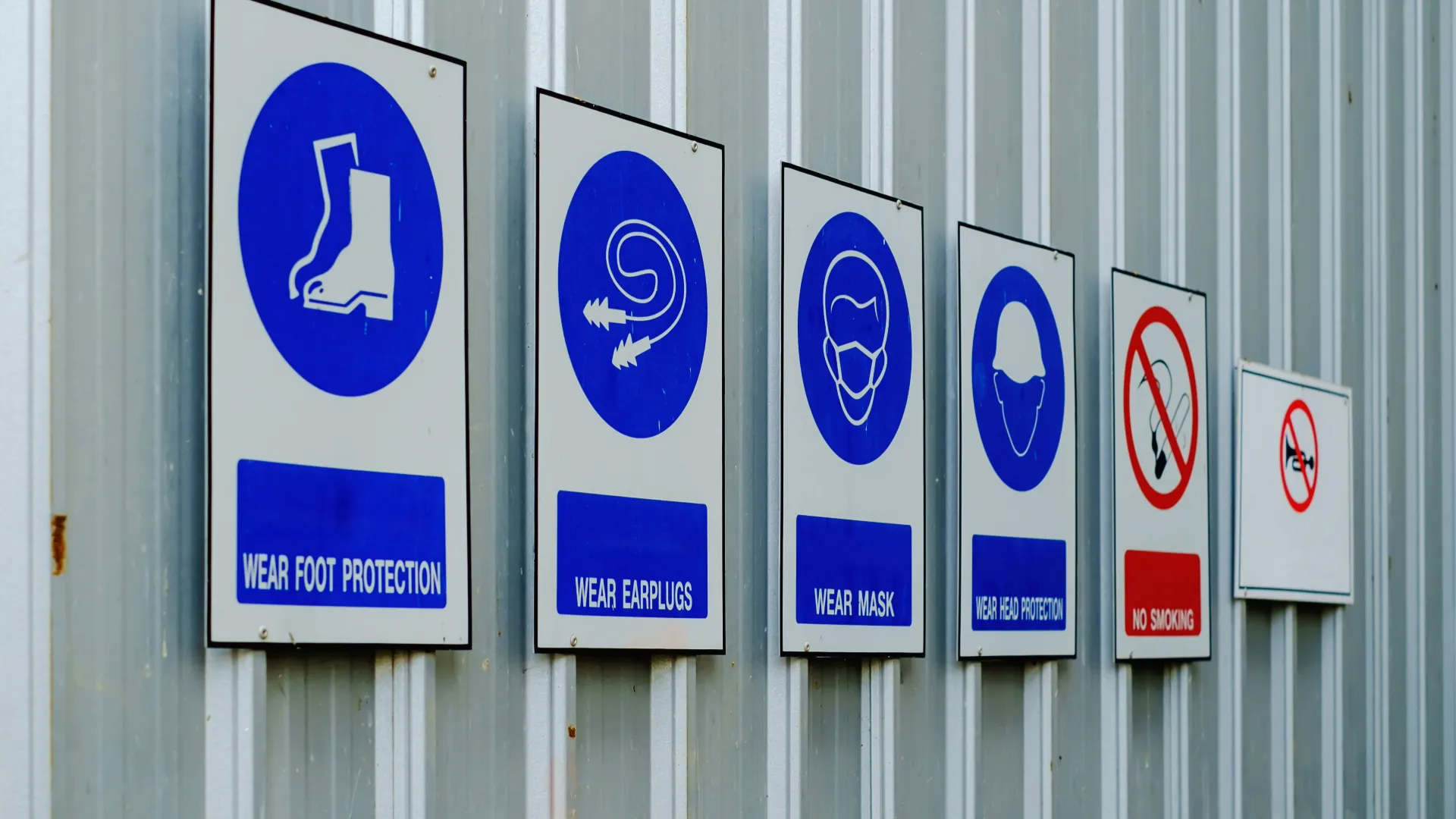
Safety signs and signals give people clear instructions about hazards, restrictions and actions they need to take while at work. On a construction site, where vehicles, machinery and different trades may all be working in the same area, these signs need to be easy to recognise and understand.
The HSE’s workplace transport guidance covers four main types: banksman signals, prohibition signs, warning signs and mandatory signs. Each has a different purpose, from warning someone about a hazard to making it clear that certain protective equipment must be worn.
In this blog, we’ll look at what each type means, how to recognise it and where it might be used on a construction site.
Why are Safety Signs Important?
Safety signs are there to warn people about risks that still remain after other safety measures have been put in place. According to HSE guidance, employers should provide and maintain safety signs where there is a significant risk to health and safety that has not been fully removed or controlled by other methods, and where displaying a sign can help reduce that risk further.
For example, measures may already be in place to reduce the risk of foot injuries on a construction site, but there could still be areas where protective footwear is needed. A mandatory sign provides a clear reminder to anyone entering that area.
Workers also need to understand the signs and signals they may come across during their work. HSE guidance states that employers should make sure employees understand their meaning and provide training where necessary, particularly where less familiar signs or signals are being used.
Banksmans Signals
A banksman uses hand signals to guide vehicle or machinery movements where the operator may have restricted visibility. This can include reversing vehicles, crane movements or manoeuvring plant around a busy construction site. HSE guidance notes that the banksman can themselves be placed within the potential danger area, so the job needs to be carried out by someone who is trained and competent.
The signals used should be simple, clear and understood by both the banksman and the operator. Standard signals cover instructions such as start, stop, move forwards, move backwards, raise, lower, left, right and emergency stop. Using the same agreed signals across a site reduces the chance of an instruction being misunderstood during a manoeuvre.
The banksman also needs a position where they can see the manoeuvre without putting themselves in danger. HSE guidance states that if an operator cannot continue safely, the movement should be stopped until further instructions are received. When reversing vehicles are being controlled by a banksman, the driver should also know to stop immediately if the banksman disappears from view.
Prohibitory Signs
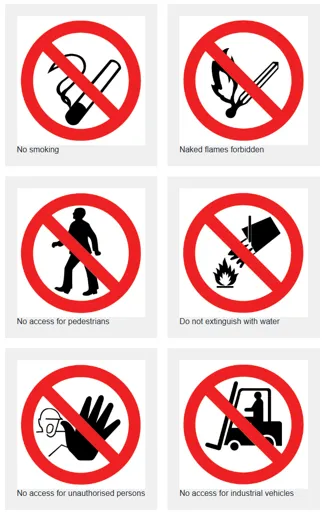
Prohibitory signs tell people that a particular action or behaviour is not allowed because it could create or increase a risk to health and safety. On a construction site, this might mean restricting pedestrian access to a vehicle route, preventing unauthorised people from entering part of the site, or making it clear that smoking and naked flames are prohibited in a certain area.
These signs are designed to be easy to recognise. They are round, with a black pictogram on a white background, surrounded by a red border and a diagonal red line through the image. HSE guidance states that the red section should make up at least 35% of the sign.
Common examples include No Smoking, No Access for Pedestrians, No Access for Unauthorised Persons, Do Not Touch and No Access for Industrial Vehicles. The exact sign used will depend on the risk and the restriction that needs to be communicated.
Prohibitory signs should be positioned where people can see and understand them before entering the area or carrying out the restricted action. As with other safety signage, they support the wider controls already in place rather than replacing physical barriers, safe systems of work or other measures used to control the risk.
Warning Signs
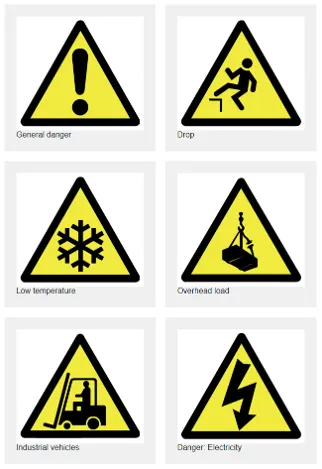
Warning signs are used to draw attention to a hazard or source of danger. On a construction site, they might be used near overhead loads, areas with moving plant, electrical hazards or changes in ground level. Their purpose is to give people enough warning to recognise the risk and take appropriate care before entering or working in the area.
These signs are triangular, with a black pictogram on a yellow background. HSE guidance states that yellow should cover at least 50% of the sign. Common examples include General Danger, Drop, Low Temperature, Overhead Load, Industrial Vehicles and Danger: Electricity.
The sign also needs to be easy to see and understand from the point where someone needs the warning. HSE guidance advises that signboards should be large enough for their intended viewing distance and positioned so they remain clearly visible. Too many signs placed together can have the opposite effect, making important warnings easier to miss.
As with other safety signs, a warning sign should support the controls already in place. For example, a sign warning of moving vehicles does not replace pedestrian segregation or a suitable traffic management system, but it can provide an extra warning where a risk remains.
Mandatory Signs
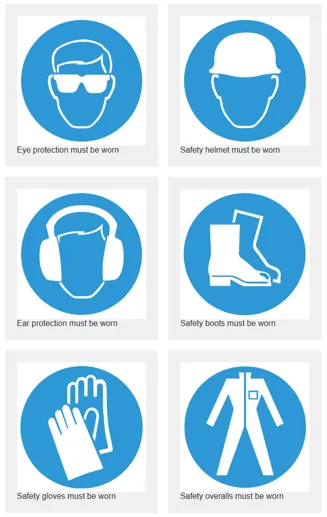
Mandatory signs tell people that a specific action must be followed. On construction sites, they are commonly used to show where particular PPE is required or where people need to follow a set route. HSE guidance describes them as signs that prescribe specific behaviour, such as requiring eye protection to be worn.
They are easy to recognise by their round shape, white pictogram and blue background, with the blue covering at least 50% of the sign. Common examples include Safety Helmet Must Be Worn, Eye Protection Must Be Worn, Ear Protection Must Be Worn, Safety Boots Must Be Worn, Safety Gloves Must Be Worn and Pedestrians Must Use This Route.
Where text is used alongside a mandatory sign, the wording should make the instruction clear. HSE guidance specifically notes that words such as “must” should be used rather than softer wording such as “should” or “may”. This removes uncertainty about whether the instruction is optional.
As with the other types of safety signage, mandatory signs work alongside the controls already in place. A hard-hat sign, for example, does not remove the hazard itself. It makes the protective action expected in that area clear to workers and visitors.
Where can I find more information?
For further guidance on safety signs and signals, the Health and Safety Executive (HSE) provides useful information on the different types of signage used in the workplace and how they should be applied.
You can read more here:
- HSE Workplace Transport: Safety Signs and Signals
- Safety Signs and Signals: The Health and Safety (Safety Signs and Signals) Regulations 1996 – Guidance on Regulations
These resources provide more detail on sign types, colours, hand signals, positioning and the responsibilities employers have when using safety signs at work.
Contact Us
If you need support with construction health and safety, Hurst Setter can help review your current arrangements and identify where improvements may be needed.
Whether you need advice on site safety, risk assessments, inspections or wider health and safety requirements, our team can provide practical support suited to your project.
Contact Hurst Setter to discuss your requirements and find out how we can help.
Speak with our Safety Experts